
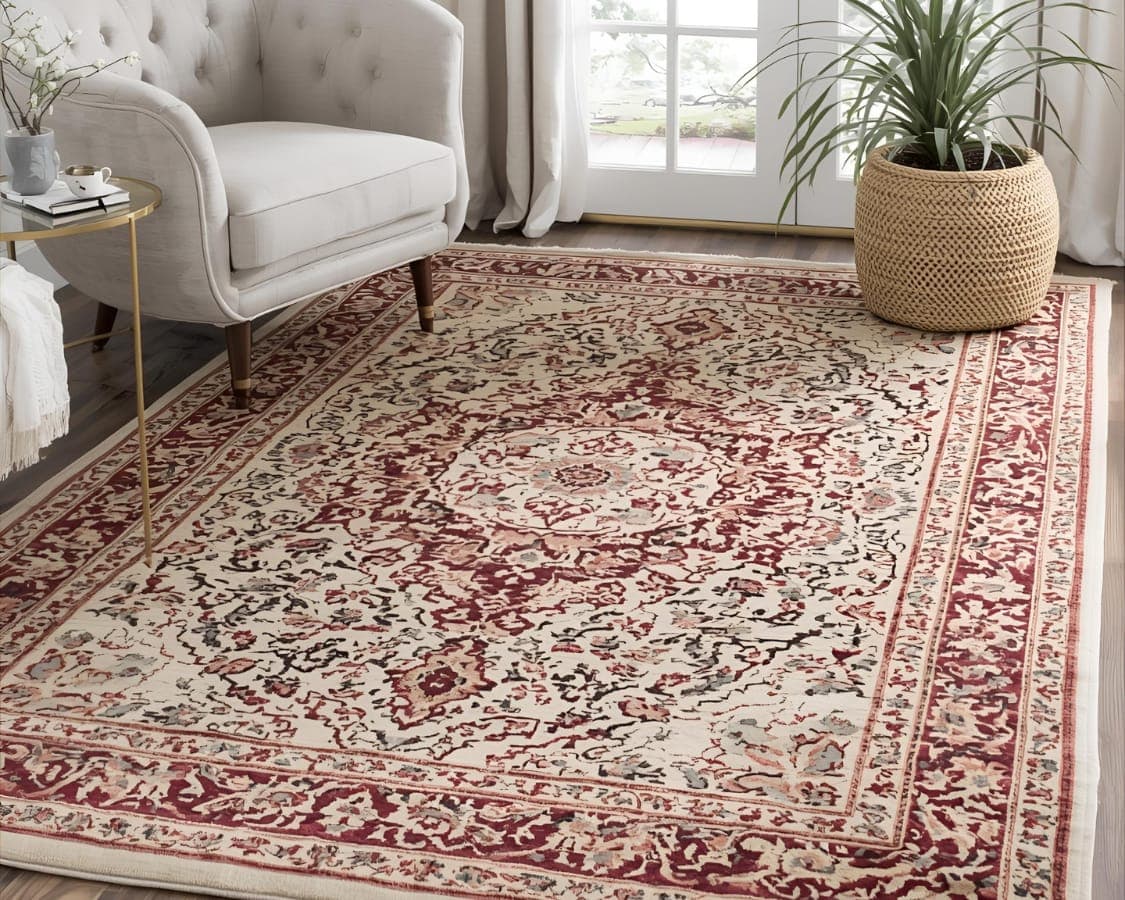
Red is the color that moves. If an oriental rug is going to bleed, it's almost always the deep reds and the dark navies running into the ivory field next to them, and once that pink blush is in the cream wool, it's very hard to get out.
That's the risk that makes people nervous about cleaning a good rug, and it's a fair worry. The good part is that dye bleeding has a short list of causes, and most of them are in your control.
Bleeding, fading and dirt look alike at first
Three different problems can make a rug's color look wrong, and they need different responses.
Bleeding means dye has physically traveled out of one area and into another. You'll see color where it doesn't belong: a red border tinting its own fringe, a blue motif with a soft blue edge.
Fading means the dye itself has weakened, usually from sunlight. The colors look washed out and the change is often uneven. Fold back the corner that's lived under the sofa and compare it to the part near the window.
Dirt is the third one, and it's the most common. Fine soil coats each fiber and scatters the light, so reds turn brick-colored, blues go grayish, and the ivory goes tan. This is the only one of the three that cleaning reverses. A rug that "faded" over ten years in a sunny Katy living room often turns out to be a rug that just needed a bath.
What makes dye run
Moisture starts it, and time makes it worse. A rug that gets soaked and then sits wet for hours gives unstable dye a long window to migrate. Several things push the odds up:
- Hot water. Heat can release some dyes that would stay put in cool water.
- Strong or high-pH cleaners, including a lot of general-purpose carpet sprays.
- Pouring liquid straight onto the rug, which carries dye down into the foundation and back out sideways.
- Slow drying, especially with the rug lying on a floor that keeps the underside damp.
Note what's missing from that list: gentle blotting with cool water on a stable rug is usually fine.
How to test a rug's colors at home
Find a spot where every color in the rug appears, ideally near an edge that sits under furniture. Dampen a white cloth with cool water (or with the product you plan to use) and press it firmly against each color for about thirty seconds. Check the cloth.
Any tint on the cloth means stop, and leave that rug to someone who can control the moisture. No tint is encouraging, but test each color separately. On the same rug, the ivory can be rock-solid while the red runs.
Use white cloths for everything, always. A colored towel hides exactly the information you need.
Handling a fresh spill on a colorful rug
Lift any solids. Blot with a white towel, pressing, never rubbing; scrubbing crushes the pile and changes how it reflects light, so even a spot where no dye moved can end up looking lighter or darker. Keep checking the towel for rug color. Use only small amounts of cool water. Then dry the area flat with a fan pointed at it, and keep furniture off it until it's dry.
Skip the "natural" vinegar and baking soda mixes on a good rug. Homemade blends vary wildly in strength, and vinegar's acidity is enough to shift some dyes.
Fringe and silk need their own rules
Fringe is often cotton while the pile is wool, so it stains differently and yellows more easily. Keep the vacuum's spinning brush off it entirely.
Silk and viscose ("art silk") pieces are a separate category. Water alone can leave them with permanent watermarks and crushed sheen. If you have one, don't try spot cleaning beyond a dry blot.
Where professional oriental rug cleaning makes sense
Call when the test cloth shows color, when a spill is large or has reached the backing, when a pet has had an accident on it, or when the rug is hand-knotted and you don't know its history. Call too when it simply looks dull a day after vacuuming. That's embedded soil, and it's the version of the problem that cleaning fixes completely.
We clean oriental rugs right in your home, so a heavy rug never has to be rolled up and hauled anywhere. Your technician tests every color before starting, picks the moisture level for that particular rug, and gives you the price up front. Our method uses very little water and no soap, which is about as color-safe as rug cleaning gets, and the rug is usually dry by the evening. The oriental rug cleaning page has the details, and our guide to cleaning wool rugs without damage goes deeper on fiber care.
What we can't do is reverse color that has already bled and set, or bring back sun-faded dye. Those cases we'll point out during the inspection.
To protect the color you have, turn rugs that sit near big windows a half turn every six months and draw the blinds in the afternoon. Then pick up the phone and dial 281-789-8998 when one starts to look dusty, before anybody reaches for a spray bottle.